Contacts: Antonella CAVANNA and Ulf GENNSER
This research activity is centred around the epitaxial growth of III-V semiconductor samples, and specifically of GaAs-based two-dimensional electron gases (2DEGs), for the study of low-temperature electronic transport properties.
2DEGs in GaAs/AlGaAs hererostructures have for a long time constituted the pre-eminent platform for the study of mesoscale electronic transport, correlated systems and topological order in reduced dimensions. This is in large part due to the 2D electrons extremely long mean free path (absence of elastic scattering) and macroscopic quantum coherence lengths (absence of inelastic scattering). These lengths can attain tens or even hundreds of µm at sufficiently low temperatures. Although today there exist also the alternative of 2D materials, the two systems are often complementary, with different advantages and disadvantage
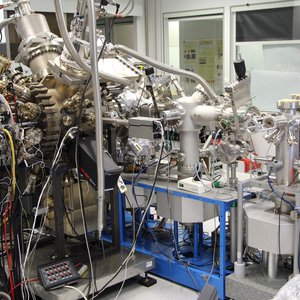
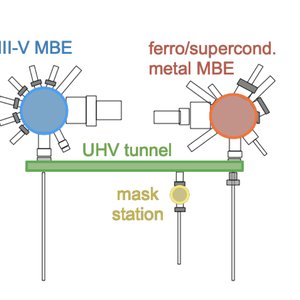
A very important activity in the Phynano group is the realisation of such 2DEGs in close collaboration with the mesoscopic transport activities within C2N as well as with the French mesoscopic physics community. For this purpose the 2DEG Team has at its disposal two systems for molecular beam epitaxy (MBE).
Hugo pursues a twofold activity at Phynano: as a postdoc for quantum transport (where he studies the effect of a resistive environment on the tunneling through a quantum dot), and in our team, where he is working on the next advances for mesoscopic physics in materials and fabrication. He has launched a project on screening wells, which were first introduced at Purdue University, allowing for the first observation of the fractional exchange phase in a Fabry-Pérot interferometer. We anticipate that these structures, where the screening wells suppress the parasitic Coulomb coupling between bulk and edge, will play an increasing role in mesoscopic physics.
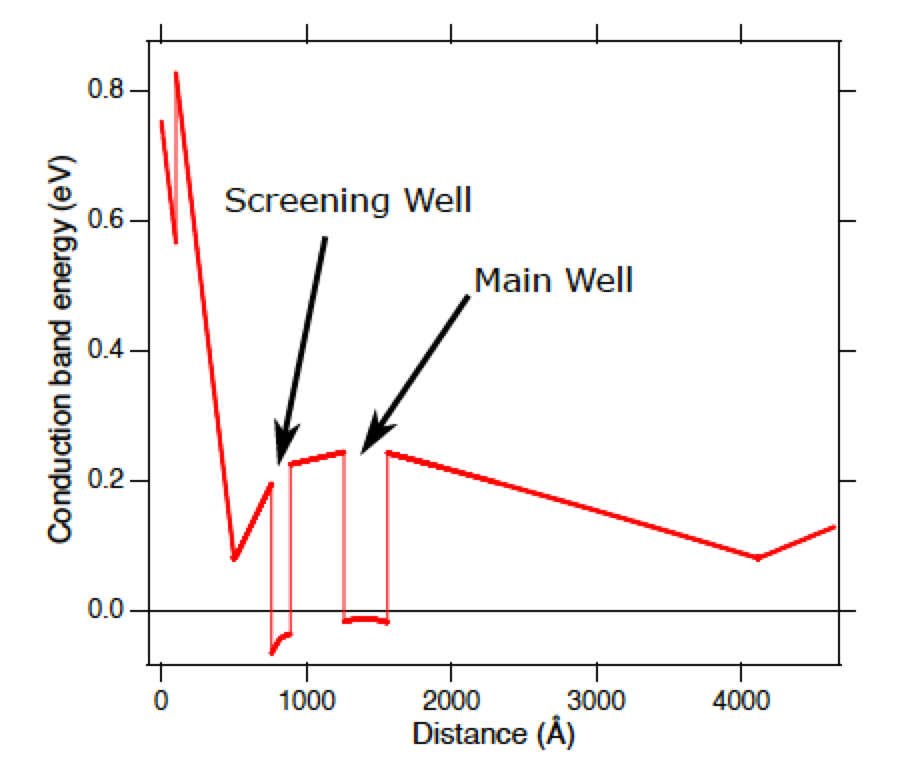

Calculated conduction band diagram of a top screening gas structure (left) and an SEM picture of an MBE-grown sample with the same structure (right).
(Epitaxial growth: Hugo Bartolomei — SEM picture: Christophe Dupuis and Hugo Bartolomei)
Fundings: